
Scott County’s Seven-Day Blotter
There is no single endless blotter here. Instead, the sheriff's Inmate Listing links today's page plus the six prior Daily Booking Reports. The general roster covers people in custody now. It adds those released within the past seven days. Those views together form the working arrest log for bookings at Scott County Jail.
Why go multi-day? A dated search suits a fuzzy memory of when someone was arrested in Scott County. It also lets readers compare agency activity. That means Davenport Police, Bettendorf Police, Eldridge Police, or the sheriff. Keep limits in mind. A citation or investigation that never reached county jail simply will not appear.
Read Scott County Reports Backward
Think of the dated links as a short ledger. Start with the day you care about and step outward one date at a time. Newer bookings sit at the top of each report, so working backward from the newest entry is the fastest route through the Scott County arrest record. Avoid treating the current roster as one frozen archive. Each page carries a last-upload marker too. That marker explains why an arrest missing on one visit can appear later.
- Open the official Scott County Inmate Listing.
- Select the most likely calendar date from today and the six preceding links.
- Scan the newest entries first, then compare name, age, agency, and booking time.
- Move to the adjacent date when an arrest happened near midnight or transport took time.
- Use the main roster’s name, agency, custody, and date controls for a cross-check.
- Follow the court docket for the case outcome, not the charge line in the jail report.
Need only today's arrests? Arrests Last 24 Hours covers activity from the current calendar day alone. The Scott County police blotter aims wider. It suits weekend catch-up, date uncertainty, and comparisons across recent arrest history rather than minute-by-minute checks.
Scott County Prior-Date View
The official prior-date booking report shows how Scott County files each day apart. Every recent date gets its own page inside the short public window.
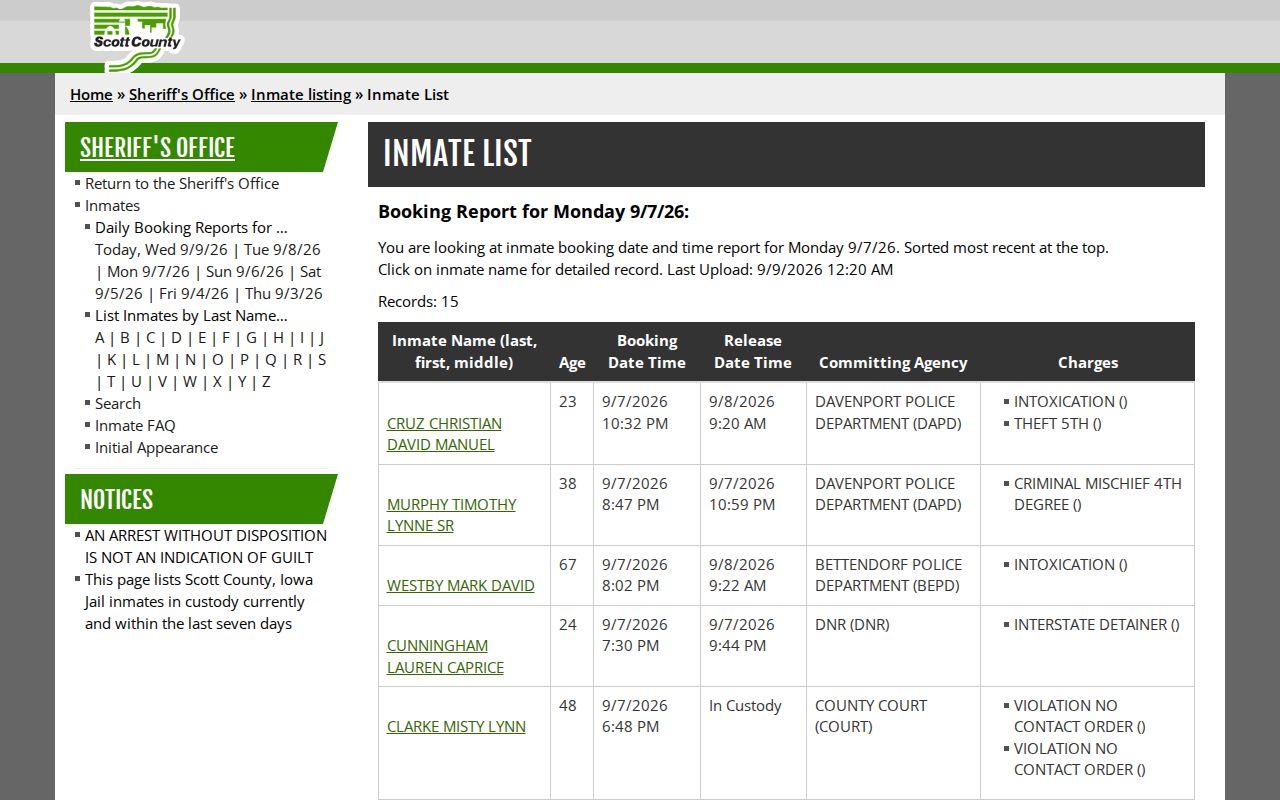
The dated heading pins the page to one report day. Names and counts shown there are historical interface content, not a standing roster. Always check the current official page for the latest Scott County arrest record.
Scott County Blotter Entry Anatomy
Read each blotter entry as a cluster of matching clues. The booking timestamp shows when the jail took the person in. That hour can differ from when police first made contact. Each entry also names a committing agency, tying the arrest to a department or court source. A release time, in turn, only marks the moment custody ended on the jail's display.
| Field | What it can establish | What it cannot establish |
|---|---|---|
| Name and age | Identity clues for comparison | Identity alone when names are similar |
| Booking date/time | When jail intake was recorded | Exact arrest time |
| Committing agency | Agency or court tied to custody | Every agency involved |
| Custody/release | Status or release time | End of the court case |
| Charges | Charges entered for reference | Guilt or final disposition |
| Photo | No visible column in the reviewed view | That no photo exists |
The daily report lists no booking-number or bond column. Do not read “In Custody” as a bond figure. Charge descriptions are booking language, not final outcomes. Iowa Courts Online and the clerk’s record are the proper next layer for disposition.
Weekend Scott County Arrest Reports
Dated arrest reports keep coming on weekends and holidays. The county promises no exact upload time for each day. A late Scott County arrest can cross midnight before booking wraps up. A report may also update after you first open it. Hopping between adjacent date pages beats expecting one date to hold every weekend event.
Scott County’s Initial Appearance page sets court timing. People facing state charges generally appear within 24 hours of booking. Regular business days run at 8:30 a.m. Weekends and state holidays use Zoom at 8:00 a.m. That schedule belongs to the courtroom, not the blotter. First appearance handles rights, bond, and next steps.
Calling a busy weekend a surge needs official statistics. Counting roster rows only gives a shifting custody snapshot, while Iowa’s official arrest-data report tracks trends by date, agency, municipality, offense, distribution, and age category.
Local Scott County Report Channels
Beyond the booking pages, two local outlets add different kinds of context. KWQC runs a rolling regional Crime page covering Davenport, Bettendorf, the Scott County Sheriff, arrests, charging, sentencing, jail matters, and Crime Stoppers. Stories drop as news develops, not on a roster schedule. Each claim still traces back to a named source, whether police, courts, or jail records.
The North Scott Press route is archival. Scott County Library describes searchable issues going back to 1968, including columns like "Scott County Sheriff's Report" and "Eldridge Police Report." Those narrative columns are not a live government feed. Yet they help with older county and Eldridge research once the seven-day jail display rolls off.
Official sources come first. Local journalism adds event context, but an omitted story never proves an arrest did not happen.
The KWQC regional Crime page is the strongest rolling news route for Scott County and its neighboring cities.
Scott County Crime News Context
The KWQC regional Crime page is the strongest rolling news route for Scott County and its neighboring cities.
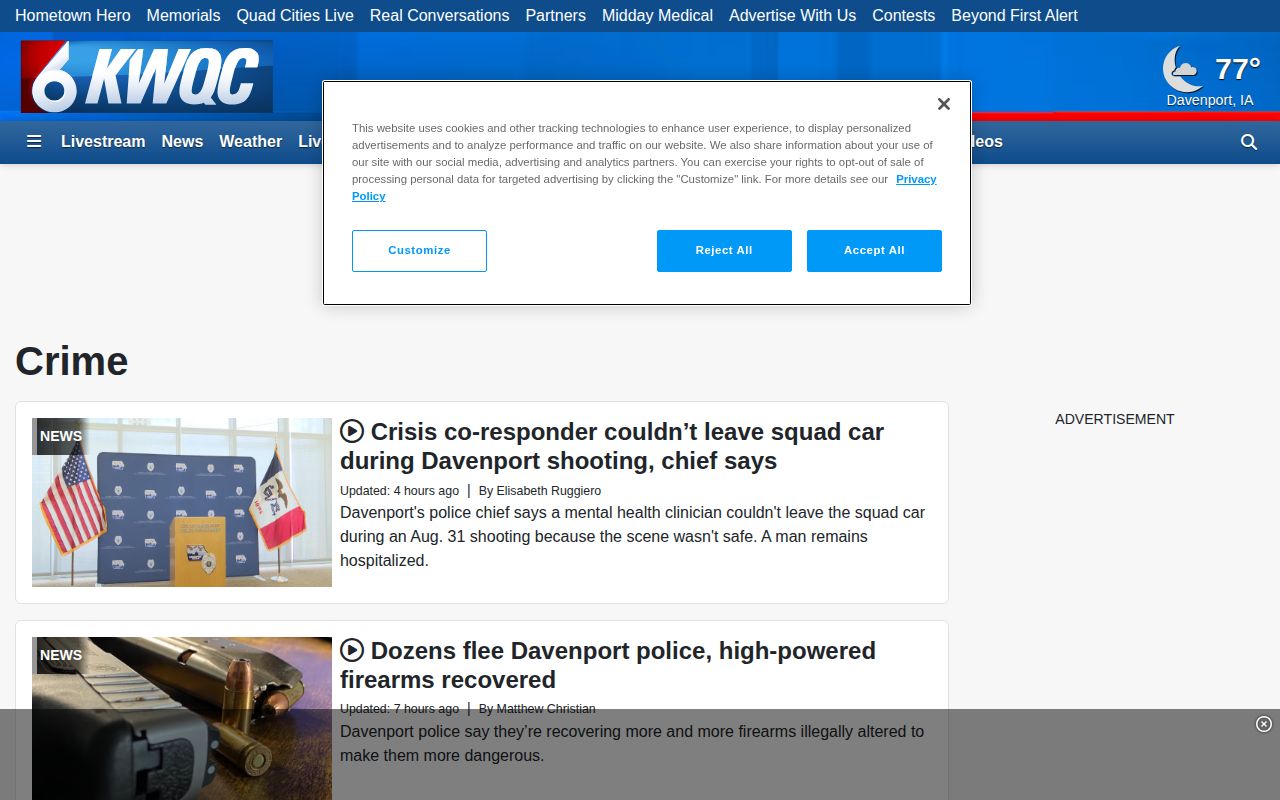
A newspaper archive works best as a follow-up step. Read it after you have already checked the official roster. Or check the court docket for Scott County recent arrests. The Scott County Sheriff's booking system it is not. Editors pick which stories run, so coverage is spotty by nature. For the weekly-paper and historical route, the Scott County Library's North Scott Press archive page lays it out.
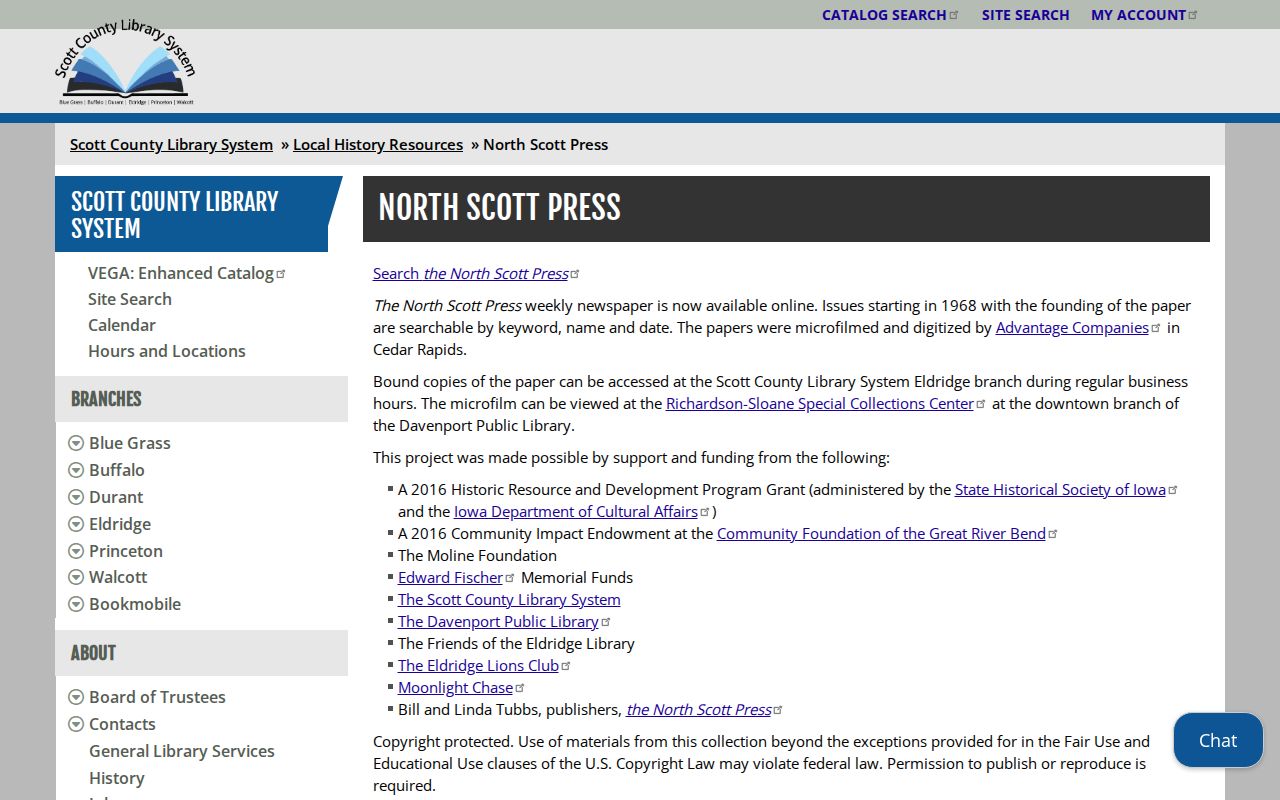
Names, dates, and old sheriff or Eldridge police columns live in that archive. Just treat it as history, not as a live arrest list or an official record of outcomes.
Beyond Scott County’s Recent Window
The seven-day rule covers public display only. It says nothing about how long Scott County keeps the booking record or booking photo behind the scenes. Neither the roster nor the sheriff records page lists a retention period for booking images. So skip the guesswork about seven years or forever. Ask the county records custodian which record series applies. Ask whether the image sits with the booking file or inside the jail-management system.
Requests can go through Scott County's open-records page, the county form, or FOIA@scottcountyiowa.gov. State the name, the approximate date, the committing agency, and the exact item you want. Treat access, retention, redaction, and fees as four separate questions. The sheriff's records and report line is 563-326-8719. It is staffed Monday through Friday, 8:00 a.m. to 4:30 p.m.
Court files play by their own rules. Iowa Court Rule 22.37 sets when a district court clerk may purge certain criminal case files. Conditions and exceptions are included. That rule has nothing to do with removing a sheriff roster entry. For prison or supervision details, go to Iowa Department of Corrections channels. Never ask the county for a state record.
Verify Scott County Arrest Outcomes
A full picture of a Scott County arrest often spans three systems. Police or sheriff records hold the event itself. The Scott County Jail tracks booking and custody. The court docket carries the outcome. "Disposition" simply means the court's final recorded result. It can look very different from the charge logged at booking. Unofficial county indexes sometimes keep stale images or doubled entries. Their data stays incomplete, so treat such sites as leads, never as a replacement for the official record. The sheriff's roster itself lists charges for reference only.
- Booking
- Jail intake and creation of a custody record.
- Charge
- An charge recorded at that stage.
- Disposition
- The outcome shown in the court case.
- Retention
- How long an agency keeps a record, different from online display.
Note: Check the name, agency, arrest date, and court outcome through official county records before relying on any Scott County blotter entry.
Scott County Agency Filters
Committing-agency choices on the roster reach past the three biggest city departments. The list also spans LeClaire Police, Walcott Police, and Blue Grass Police. It adds Iowa State Patrol, District Magistrate, and County Court. Iowa DOC, RCF, and the Work Release Center round it out. That spread explains why a blotter entry might point to a court or correctional source rather than the department you expected. Filter broadly. Then confirm the record's origin with the named agency.
An agency filter narrows a search. It cannot prove which officer made the arrest or which office holds the incident report. Court, magistrate, work-release, and correctional entries often reflect later process instead. Use the booking date and charge as starting clues. Then ask the named custodian for the source record when that distinction matters.
Search Public Records
Sponsored Results